

AXIA Projects
AXIA Builder
From Design Principles to Functional Websites
A desktop application that brings together website architecture, content management, interface design, and publishing workflows to help create consistent, accessible, and production-ready websites through a structured visual experience.
My Role
Creator & End-to-End Product Lead
Project Type
Desktop Application · Web Authoring
Product Capabilities
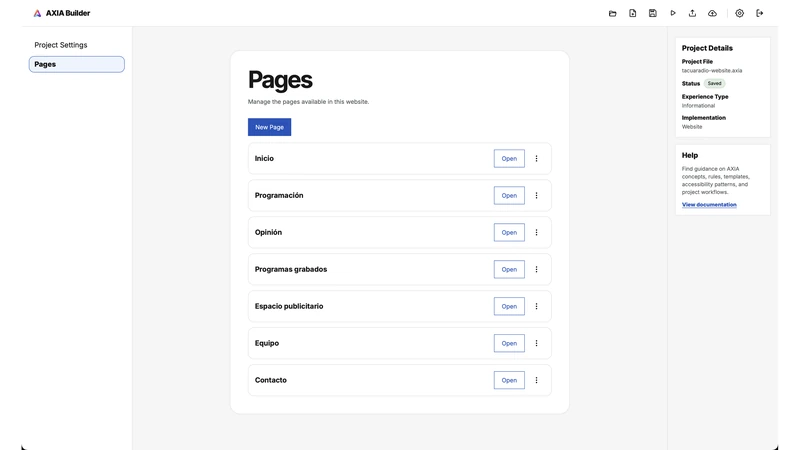
- Visual Website Authoring: An organized editing environment for managing website content, page configuration, navigation, and visual presentation without editing source directly.
- Structured Templates: Reusable page templates for content-rich presentations, multimedia, contact information, blogs, programming schedules and internet radio.
- Centralized Site Configuration: Site-wide controls for identity, branding, page organization and social sharing metadata.
- Preview & Iteration: A browser-based preview workflow to examine and refine the resulting website.
- Project Portability & Publishing: Saving portable AXIA projects and exporting deployable static website files independently of the authoring app.
Overview
AXIA Builder is a desktop application designed to simplify the creation and management of static websites while maintaining a strong foundation of user experience, accessibility, consistency, and technical quality.
Built as an implementation of AXIA Framework, the application translates structured design principles into a practical website-building experience. Users can configure site-wide settings, create pages, select templates, manage content, preview their work, and generate websites ready for publishing.
Rather than treating visual design, content structure, and implementation as disconnected activities, AXIA Builder brings them together within a guided authoring environment.
The application is developed using Tauri, React, TypeScript, and Vite, combining web technologies with a native desktop application experience.
The Challenge
Creating and maintaining websites often involves navigating multiple layers of complexity, including content organization, design consistency, responsive behavior, accessibility requirements, and deployment.
Visual website builders can simplify some of these tasks, but they may also introduce inconsistencies, unnecessary dependencies, or limitations in the quality and portability of the resulting websites.
AXIA Builder was conceived to explore a different approach: providing a structured visual environment that makes website creation more approachable while preserving explicit design rules, predictable behavior, and control over the final output.
The challenge extended beyond developing a visual editor. It required translating architectural and UX principles into understandable interactions, reusable templates, reliable content workflows, and an accessible application experience.
Designing the Authoring Experience
AXIA Builder required designing an application for people working with website content and structure, not simply arranging technical controls around a rendering engine.
The experience emphasizes clear organization, understandable field relationships, predictable interactions, and feedback that helps users recognize what is happening as they work.
A central design consideration is balancing flexibility with structure: providing enough freedom to create different kinds of websites while maintaining the consistency and quality expectations established by AXIA Framework.
Key UX considerations: Clear Workflows · Keyboard Accessibility · Meaningful Feedback · Consistent Patterns.
Accessibility by Design
Accessibility is considered at two complementary levels: the experience of using AXIA Builder itself and the structure of the websites it generates.
Within the application, attention is given to keyboard navigation, focus management, form labeling, validation, error communication, and predictable interaction behavior.
For generated websites, AXIA principles inform structural semantics, content requirements, navigation patterns, responsive behavior, and accessibility-related design decisions.
This approach treats accessibility as an ongoing product responsibility rather than a feature added after the interface is complete.
Design for Implementation
One of the defining aspects of AXIA Builder is the relationship between visual editing and the resulting implementation.
Instead of producing disconnected design artifacts that require interpretation before development, the application transforms configured content and design decisions into functioning website files.
Templates, content structures, and authoring rules are connected to implementation behavior, helping preserve consistency between what users configure and what the application generates.
This reflects a central principle of my work: design decisions should be actionable and should remain meaningful throughout implementation.
Technology & Development
Tauri (desktop application), React (interface), TypeScript (application logic), Vite (development tooling), Rust (native integration), AXIA Framework (design principles). The resulting static websites can be deployed separately from the desktop authoring app.
Real-World Application
AXIA Builder's website generation approach has been applied to projects including Tacuaradio, a community radio website with streaming and dynamic-content integrations.
My Contribution
I conceived AXIA Builder and lead its evolution across product strategy, requirements definition, information architecture, UX/UI design, application behavior, technical architecture, development, testing, and quality improvement.
My involvement includes translating AXIA Framework principles into practical authoring rules, defining the editor's workflows and interaction patterns, designing reusable templates, and shaping the relationship between the application interface and the generated websites.
The project draws on my experience in enterprise UX, software development, accessibility, and product architecture, allowing me to approach the application from both the user's perspective and the technical requirements of implementation.
It also serves as an ongoing exploration of how sophisticated product capabilities can be made approachable without compromising structural consistency or long-term maintainability.
Outcomes & Ongoing Evolution
AXIA Builder has evolved into a functional desktop website-authoring application that demonstrates how design rules can be translated into reusable interfaces, configurable content structures, and deployable static websites.
The project brings together several disciplines—product design, interface architecture, software development, accessibility, and quality assurance—within a single product experience.
Its continued development provides opportunities to refine authoring workflows, expand template capabilities, strengthen accessibility, and improve the consistency between product configuration and generated output.
Rather than being a requirement for using AXIA Framework, Builder represents one practical implementation of its principles, while the framework itself remains independent of any particular technology or application.